

Future IIMer, you are looking at one of India's most sought-after undergraduate management programs. The IIM Bangalore UG Entrance Exam, while conceptually similar to IPMAT Indore in its rigour, demands a focused approach. This exam is your gateway to a prestigious B-school experience right after Class 12.
Here is what you'll learn in this guide:
- The complete exam pattern, including section-wise questions and time limits.
- A curated list of essential books and resources for Quantitative Aptitude, Verbal Ability, and Logical Reasoning.
- A step-by-step strategy to ace the exam, from your first mock to D-Day.
Tl;dr: IIM bangalore UG entrance exam in a nutshell
This exam is a 120-minute test with 60 questions across three sections: Verbal Ability (English Comprehension), Logical Reasoning, and Quantitative Aptitude. The difficulty level is moderate to difficult, often compared to IPMAT Indore, sometimes even a notch higher. Success hinges on a strong foundation, consistent practice with previous year papers (IPMAT, JIPMAT), and strategic time management. Start with a free mock to gauge your current standing.
Decoding the iim bangalore ug entrance exam
The IIM Bangalore UG Entrance Exam sets a high bar for aspiring management professionals. It tests your aptitude across critical areas, ensuring that only the most prepared candidates make it through. Think of it as your first major step towards joining the league of IIM alumni.
Recently, IIM Lucknow also launched its BS Artificial Intelligence program for undergraduates. However, that program currently accepts JEE Advanced scores, making it primarily for science stream students. For commerce and other stream aspirants aiming for a management career, the IIM Bangalore UG Entrance Exam, or similar IPMAT-style exams, remains the direct path. You can read more about the IIM Lucknow program here.
Understanding the structure and demands of the IIM Bangalore UG Entrance Exam is non-negotiable. It is not just about knowing the syllabus; it is about mastering the art of taking the exam efficiently. This includes knowing which sections to prioritise and how to manage your time effectively under pressure.
Iim bangalore ug entrance exam pattern: a detailed breakdown
The IIM Bangalore UG Entrance Exam is a 120-minute paper designed to test your analytical, logical, and linguistic abilities. It comprises 60 questions distributed across three distinct sections. The difficulty is on the higher side, making it crucial to prepare thoroughly.
Here is a detailed breakdown of the exam pattern:
| Section | Duration (Minutes) | Number of Questions | Recommended Attempts (approx.) | Difficulty Level (approx.) |
|---|---|---|---|---|
| Verbal Ability (English Comp.) | 30 | 15 | 10-12 | Moderate |
| Logical Reasoning | 30 | 15 | 10-12 | Moderate to Difficult |
| Quantitative Aptitude | 60 | 30 | 20-22 | Moderate to Difficult |
| Total | 120 | 60 | 40-46 | Moderate to Difficult |
Let's break down each section further:
Verbal ability (english comprehension)
This section primarily focuses on your grasp of English language, grammar, and comprehension skills. With 15 questions in 30 minutes, speed reading and accuracy are paramount. Expect questions from:
- Reading Comprehension: Multiple passages testing your ability to understand and infer information.
- Grammar: Error spotting, sentence correction, and fill-in-the-blanks based on grammatical rules.
- Vocabulary: Synonyms, antonyms, analogies, and usage-based questions.
- Para Jumbles: Reordering sentences to form a coherent paragraph.
- Critical Reasoning: Analysing arguments, identifying assumptions, and drawing conclusions.
Logical reasoning
Logical Reasoning tests your ability to think critically and solve problems using given information. This 30-minute section, with 15 questions, requires sharp analytical skills. Key topics include:
- Seating Arrangement: Linear, circular, or complex arrangements.
- Blood Relations: Family tree problems.
- Direction Sense: Mapping movements and final positions.
- Series: Number, alphabet, and mixed series.
- Puzzles: Logic-based puzzles requiring careful deduction.
- Syllogisms: Drawing conclusions from statements.
- Clocks & Calendars: Problems related to time and dates.
Quantitative aptitude
This is the longest section, with 30 questions to be solved in 60 minutes. The Quant section is often considered the most challenging, similar to or slightly tougher than IPMAT Indore's Quant section. A strong foundation in Class 9-10 mathematics is essential.
Key areas to focus on are:
- Arithmetic: Percentage, Profit & Loss, Simple Interest & Compound Interest, Ratio & Proportion, Time & Work, Speed, Time & Distance.
- Algebra: Linear Equations, Quadratic Equations, Progressions (AP, GP, HP), Inequalities, Functions.
- Geometry: Mensuration, Triangles, Circles, Coordinate Geometry basics.
- Modern Maths: Permutations & Combinations, Probability.
- Data Interpretation: Analysing data presented in tables, charts, and graphs.
Essential books & resources for each section
Choosing the right study material can make all the difference. Avoid collecting too many books; focus on quality and comprehensive coverage. Here are the recommended resources:
For quantitative aptitude
To master Quant, you need to build concepts and practice extensively. These books are widely trusted by top aspirants:
- "Quantitative Aptitude for Competitive Examinations" by R.S. Aggarwal: This is a foundational book for building speed and accuracy with basic to intermediate problems.
- "Quantitative Aptitude for CAT" by Arun Sharma (Levels 1, 2, 3): For a higher level of difficulty and conceptual clarity, especially for topics like Algebra, Geometry, and Modern Maths, Arun Sharma's books are excellent. Start with Level 1 and gradually move to Level 2 and 3.
Focus on clearing your basics from Class 9-10 NCERTs first, then move to these advanced books. Practice topic-wise questions diligently.
For verbal ability
Verbal ability requires a consistent effort to improve reading habits, vocabulary, and grammar. The following books are highly effective:
- "Word Power Made Easy" by Norman Lewis: This book is indispensable for building a strong vocabulary. It teaches you roots, prefixes, and suffixes, making it easier to understand new words.
- "High School English Grammar and Composition" by Wren & Martin: For mastering grammar rules and their application, this classic is unbeatable. Work through all the exercises to solidify your understanding.
Regularly read newspapers (like The Hindu or The Indian Express) and quality magazines to improve your reading speed and comprehension.
For logical reasoning
Logical Reasoning skills are honed through practice. The more variety of problems you solve, the better you become.
- "A Modern Approach to Logical Reasoning" by R.S. Aggarwal: This book covers a vast range of LR topics, from analytical reasoning to verbal reasoning. It is ideal for building a strong base and practicing diverse question types.
- "A New Approach to Reasoning" by B.S. Sijwali and Indu Sijwali: Another excellent resource for practicing advanced LR problems and understanding different methodologies.
General resources & practice material
Beyond specific books, integrating these resources into your study plan is crucial:
- Previous Year Papers (PYQs): Crucially, solve PYQs of IPMAT Indore, JIPMAT, and NPAT. While direct IIM Bangalore UG papers might be limited, these exams offer a similar difficulty and pattern. They give you a real feel for the exam environment.
- IPM Careers Free Mock Tests: Before you even start serious preparation, take a free mock test from our portal. This helps you identify your strengths and weaknesses early on. It shows you exactly where you stand.
- YouTube Channels: Many channels offer shortcuts and conceptual clarity for Quant and LR. Use them judiciously to supplement your book study, not replace it.
Your strategic roadmap to success
Cracking the IIM Bangalore UG Entrance Exam requires more than just knowing the syllabus. It demands a well-thought-out strategy, discipline, and continuous self-assessment. Here is how you can approach your preparation:
Step 1: start with a diagnostic mock
As soon as you decide to prepare, take a full-length free mock test. This initial test is not about scoring high; it is about understanding the exam structure, your current proficiency, and identifying areas that need immediate attention. Do not skip this crucial step.
Step 2: analyse and build fundamentals
After your mock, analyse every question, whether correct or incorrect. Understand why you made mistakes. Then, dive into building strong conceptual clarity for each topic across Quant, Verbal, and LR. Use the recommended books to cover every concept thoroughly.
Step 3: topic-wise practice and revision
Once concepts are clear, practice topic-wise questions. Start with easier questions and gradually move to moderate and difficult levels. Regularly revise previously covered topics to ensure retention. Consistency is key here; a few hours daily are more effective than marathon sessions once a week.
Step 4: full-length mock tests and time management
As you progress, start taking full-length mock tests regularly, ideally once a week. These mocks help you improve your speed, accuracy, and time management skills. Crucially, analyse each mock to identify patterns in your errors and refine your test-taking strategy.
Step 5: review previous year papers
Solving previous year papers of IPMAT Indore and JIPMAT is non-negotiable. These papers give you the most accurate representation of the exam's difficulty and question types. Treat them as actual mock tests and solve them under timed conditions.
Your journey to IIM Bangalore's UG program is a marathon, not a sprint. Stay focused, stay consistent, and trust the process. If you need any help or guidance, our expert counsellors are just a call away. You can reach out to us on WhatsApp at wa.me/918299470392 or explore our tools at register.ipmcareer.com.
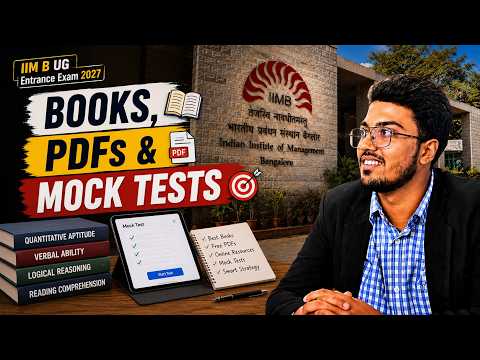
Watch the full discussion and get more insights from our experts here:
Frequently asked questions
What is the syllabus for iim bangalore ug entrance exam?
The IIM Bangalore UG Entrance Exam syllabus covers Quantitative Aptitude (Arithmetic, Algebra, Geometry, Modern Maths, Data Interpretation), Verbal Ability (Reading Comprehension, Grammar, Vocabulary, Para Jumbles, Critical Reasoning), and Logical Reasoning (Seating Arrangement, Blood Relations, Series, Puzzles, Syllogisms, etc.). It is very similar to the IPMAT Indore syllabus.
What are the best books to prepare for the iim bangalore ug entrance exam?
For Quantitative Aptitude, recommended books are R.S. Aggarwal's "Quantitative Aptitude" and Arun Sharma's "Quantitative Aptitude for CAT" (Levels 1-3). For Verbal Ability, use Norman Lewis's "Word Power Made Easy" and Wren & Martin's "High School English Grammar and Composition." For Logical Reasoning, R.S. Aggarwal's "A Modern Approach to Logical Reasoning" is highly effective.
How difficult is the iim bangalore ug entrance exam compared to ipmat indore?
The IIM Bangalore UG Entrance Exam is considered to be of moderate to difficult difficulty, often compared to IPMAT Indore. Some aspirants find certain sections, especially Quantitative Aptitude, to be slightly higher in difficulty than IPMAT Indore. Consistent practice and strong conceptual clarity are crucial for both exams.